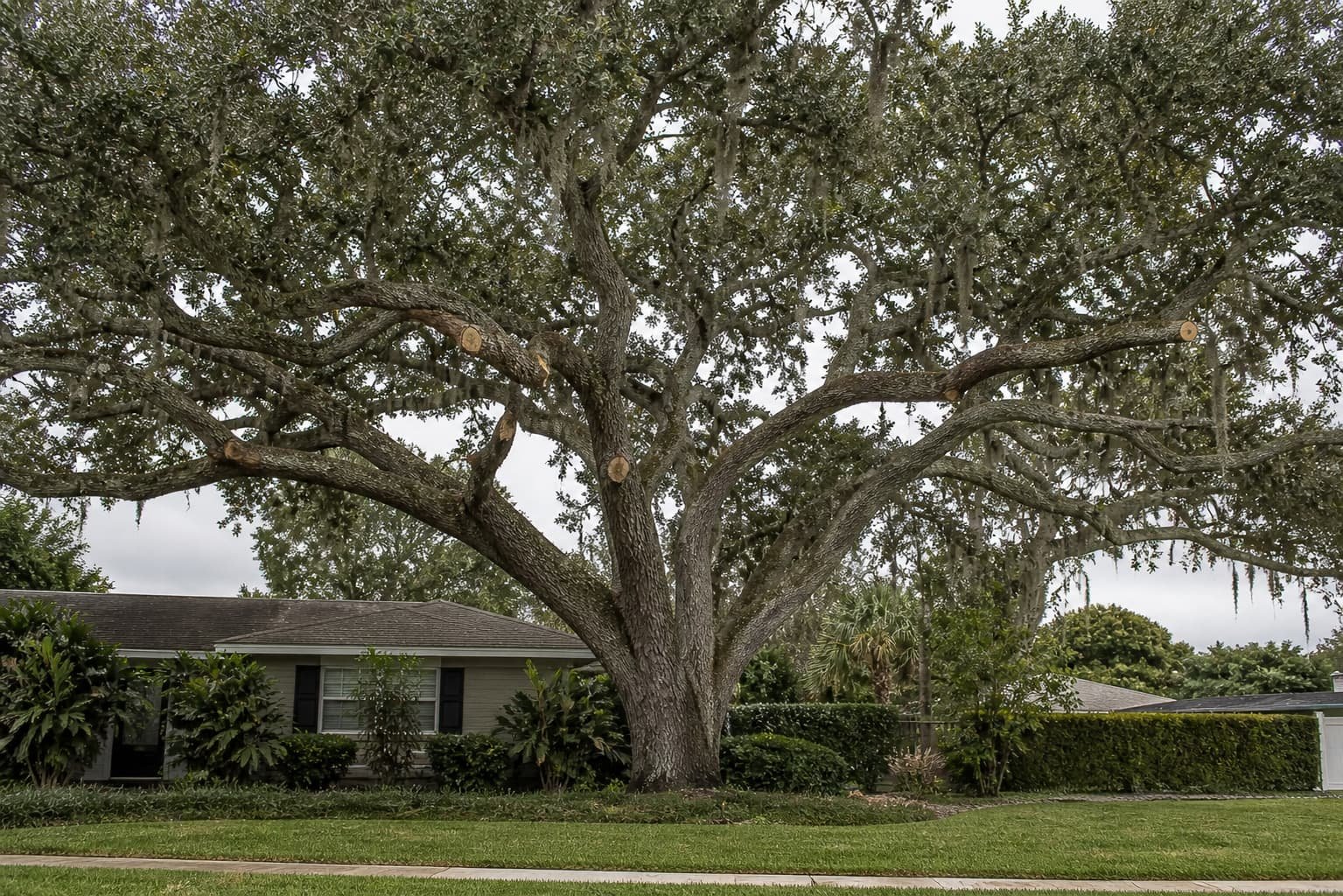
Live oak trimming in Florida is one of the most common tree care questions we receive at Tree Care Gainesville, and for good reason. Live oaks are the defining tree of Gainesville’s residential canopy — the wide-spreading, Spanish moss-draped specimens that arch over streets and yards across the city are almost all live oaks, and keeping them healthy and structurally sound requires the right approach at the right time of year. Get it wrong and you risk disease entry, poor regrowth, and long-term structural problems. Get it right and a well-trimmed live oak will be a centrepiece of your property for decades.
Why Live Oak Trimming Timing Matters in Florida
Live oak trimming in Florida is most safely carried out between late fall and early winter — roughly November through January. During this period, live oaks are at their least actively growing, wounds close more slowly but with lower disease risk, and the fungal pathogens that cause oak wilt are less active. Trimming live oaks during the warmer months — particularly in spring when new growth is emerging — creates fresh wounds that are significantly more susceptible to infection.
Oak wilt is a serious fungal disease that has caused widespread damage to oak populations across the United States. While it is less established in Florida than in some other states, it is present and worth taking seriously. The fungus spreads through root grafts between neighbouring trees and via sap-feeding beetles that are attracted to fresh pruning wounds. Carrying out live oak trimming in Florida during the low-risk winter window significantly reduces the chance of introducing the pathogen to your trees.
What Live Oak Trimming Should and Should Not Remove
Effective live oak trimming in Florida focuses on removing specific categories of growth rather than simply reducing the overall size of the tree. Dead, dying, and diseased branches should always be removed — these are entry points for pests and pathogens and add unnecessary weight to the canopy. Crossing branches — those that rub against other branches and create wounds — should be addressed before the rubbing causes damage to both. Branches with included bark at the union with the trunk or a major limb are structurally weak and should be removed while they are still manageable in size.
What live oak trimming should not do is top the tree. Topping — cutting the main stems back to stubs — is one of the most damaging things you can do to a live oak. It destroys the tree’s natural structure, creates large wounds that are slow to compartmentalise, stimulates the production of weakly attached epicormic shoots, and ultimately shortens the tree’s life. If a live oak has grown too large for its location, the correct response is a programme of gradual reduction carried out by a qualified arborist over several years — not topping.
Hurricane Preparation and Live Oak Trimming
Live oak trimming in Florida takes on additional importance in the context of hurricane season. While live oaks are among Florida’s most wind-resistant native trees, their broad, dense canopies create significant wind resistance in high winds. Canopy thinning — removing selected branches throughout the canopy to allow wind to pass through rather than push against a solid wall of foliage — is one of the most effective pre-season measures you can take to reduce storm risk.
Canopy thinning for hurricane preparation is best carried out in the late fall to winter window, aligning with the safest period for live oak trimming in Florida. This gives the tree time to begin compartmentalising the pruning wounds before the following hurricane season begins in June. Tree Care Gainesville recommends a pre-season assessment for any Gainesville property with large live oaks close to structures — identifying and addressing structural weaknesses before a storm is always preferable to dealing with the aftermath of a failure.
Live Oaks and Gainesville’s Canopy Ordinance
Live oaks in Gainesville are among the most commonly protected trees under the city’s canopy ordinance. While trimming a protected live oak does not require a permit in the same way that removal does, it is worth being aware that certain types of work — particularly work that could be construed as damaging or devaluing a protected tree — can attract scrutiny under the ordinance. Tree Care Gainesville carries out all live oak trimming in Florida in accordance with ISA standards, ensuring that the work we do enhances rather than compromises the long-term health and structure of protected trees.
Spanish Moss and Live Oak Trimming
Live oak trimming visits are also a good opportunity to assess and manage Spanish moss coverage. As we discussed in our guide to Spanish moss, the plant does not directly harm healthy trees — but very heavy coverage can reduce light penetration into the inner canopy and add significant weight to branches. During live oak trimming visits, Tree Care Gainesville assesses moss coverage and thins it where it has become excessive, particularly on older or structurally compromised branches.
How Often Should Live Oaks Be Trimmed?
For most residential live oaks in Gainesville, a trimming cycle of every three to five years is appropriate. Young trees may benefit from more frequent formative pruning to establish good structure early. Older trees with established canopies typically need less frequent intervention — the focus shifts from shaping to maintenance, with dead wood removal and occasional structural pruning as the primary tasks.
The right cycle for your specific trees depends on their size, age, location, and condition. Tree Care Gainesville assesses each tree individually and recommends a maintenance programme based on what we find rather than applying a one-size-fits-all schedule. For further guidance on live oak care and arboricultural best practice, visit the International Society of Arboriculture.