Emergency tree removal is something no homeowner wants to deal with, but knowing the signs that a tree needs to come down immediately can be the difference between a managed removal and a dangerous unplanned failure. In Gainesville, where native species like live oak, laurel oak, slash pine, and sweet gum grow to considerable size, a failing tree close to a home or structure is a serious hazard. Tree Care Gainesville responds to emergency tree removal calls across Gainesville and the surrounding region, and this guide covers the key warning signs that should prompt you to act without delay.
Emergency Tree Removal Sign 1 — Severe Lean
Emergency tree removal is often triggered by a tree that has developed a sudden or pronounced lean. A slight lean is not always cause for alarm — many trees grow at an angle without posing a risk. But a tree that has visibly shifted position, particularly one that was previously upright and has begun leaning after a storm or period of heavy rain, is showing signs of root failure that require immediate professional assessment.
In Gainesville’s sandy soils, root systems grow shallow and wide rather than deep. This makes trees more susceptible to tipping in saturated ground, and a tree that leans sharply after heavy rainfall may have a root plate that has already begun to lift. If you notice soil heaving or cracking around the base of a leaning tree, treat it as an emergency — do not wait to see if it worsens.
Emergency Tree Removal Sign 2 — Hanging or Broken Limbs
Large hanging or partially broken limbs — what arborists call widow makers — are one of the most common triggers for emergency tree removal calls in Gainesville, particularly after tropical storms and hurricanes. A limb that has snapped but remains attached to the tree by a strip of bark or wood can fall without warning, and the weight of a major limb from a mature live oak or slash pine is sufficient to cause serious injury or significant structural damage to whatever it lands on.
If you have a hanging limb overhead after a storm, do not walk beneath it and do not attempt to remove it yourself. Call Tree Care Gainesville at (352) 703-5747 immediately. Hanging limb removal requires the right equipment and technique to bring the limb down in a controlled manner without causing further damage.
Emergency Tree Removal Sign 3 — Root Damage or Exposure
Visible root damage is a serious warning sign that emergency tree removal may be required. If you can see major roots that have been severed — by construction work, utility trenching, or soil disturbance — the tree’s structural anchoring may be compromised even if the canopy still looks healthy. Root damage does not always produce immediate visible symptoms in the canopy; a tree can appear fine for a season or more before the effects of root loss become apparent.
Root exposure — where the root plate has lifted partially out of the ground — is a more immediate warning sign. This indicates that the tree’s anchoring has already begun to fail and that full uprooting is a real possibility. Emergency tree removal in this situation should not be delayed.
Emergency Tree Removal Sign 4 — Trunk Decay and Cavities
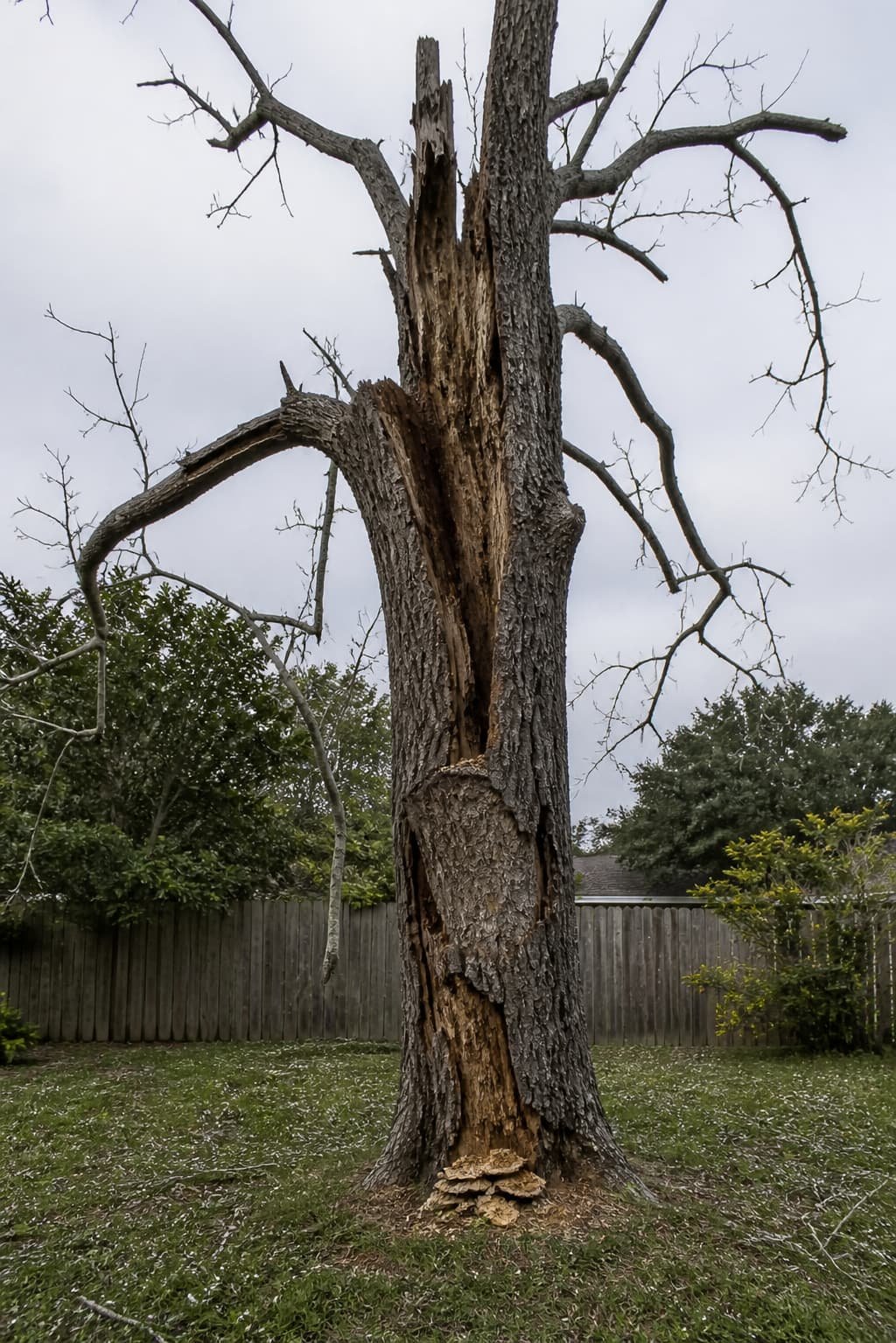
Internal trunk decay is one of the most dangerous conditions a tree can have, precisely because it is not always visible from the outside. A tree with significant internal decay can appear healthy — with a full canopy and intact bark — while the structural wood at the core of the trunk has been largely consumed by fungal rot. The first external sign is often a cavity, a hollow section of trunk, or the appearance of fungal fruiting bodies — shelf fungi or conks — growing from the bark.
In Gainesville’s warm, humid climate, wood-decaying fungi establish readily in damaged or stressed trees. Slash pine and sweet gum are particularly susceptible to certain fungal pathogens, and older live oaks can develop significant internal cavities over decades of growth. If you notice fungal growth at the base of a tree trunk or a visible hollow in the trunk, contact Tree Care Gainesville for an assessment — emergency tree removal may be required depending on the extent of the decay and the tree’s proximity to structures.
Emergency Tree Removal Sign 5 — Storm Damage
Hurricane and tropical storm damage is the most common trigger for emergency tree removal calls across Gainesville and Alachua County. The Atlantic hurricane season runs from June through November, and even a tropical storm well below hurricane strength can bring down large trees and major limbs across residential neighbourhoods. A tree that has fallen onto a roof, blocked a driveway, or landed across a fence line requires immediate attention.
After any significant storm event, walk your property carefully before approaching damaged trees. Look for overhead hazards before moving beneath any storm-damaged canopy. If a fallen tree or limb has contacted power lines, stay clear and contact your utility provider before doing anything else. Once the scene is safe, call Tree Care Gainesville for emergency tree removal and we will respond as quickly as conditions allow.
Emergency Tree Removal Sign 6 — Cracks in the Trunk
Vertical cracks running down the trunk of a tree, or cracks at the junction between a major limb and the trunk, are indicators of structural failure that may require emergency tree removal. Cracks at branch unions — particularly where included bark is present — indicate a weak attachment that can fail suddenly under wind load or the weight of the branch itself. A large crack that has appeared suddenly, particularly after a storm or period of high winds, should be treated as an emergency.
Tree Care Gainesville carries out structural assessments for trees showing signs of cracking or splitting. In some cases, cabling or bracing can provide supplemental support that extends the life of a structurally compromised tree. In others, emergency tree removal is the only safe option. For further information on tree safety and arboricultural standards, visit the International Society of Arboriculture.