Gainesville tree ordinance rules catch many homeowners off guard. If you are planning to remove a tree on your property — whether it is dead, damaged, or simply in the wrong place — there is a good chance you will need a permit before any work begins. Understanding what the Gainesville tree ordinance covers, which trees are protected, and what the permit process involves can save you significant time, money, and stress. Tree Care Gainesville works within the ordinance on every job we carry out in the city, and this guide covers the key points every homeowner should know.
What Is the Gainesville Tree Ordinance?
The Gainesville tree ordinance is a set of local regulations designed to protect and maintain the city’s urban tree canopy. Gainesville has long been recognised as one of Florida’s most tree-rich cities, and the ordinance reflects the city’s commitment to preserving that canopy as the city grows and develops. The ordinance applies to trees on private property as well as public land — the fact that a tree is on your property does not automatically mean you can remove it without permission.
The Gainesville tree ordinance is administered by the City of Gainesville’s Department of Sustainable Development. It sets out which trees are protected, what size threshold triggers permit requirements, what the application process involves, and what mitigation is required when a protected tree is removed. Violations can result in significant fines and requirements to replant, so understanding the rules before starting any tree work is essential.
Which Trees Are Protected?
The Gainesville tree ordinance protects trees that meet certain size thresholds, measured by diameter at breast height — DBH — which is the trunk diameter measured at 4.5 feet above ground level. Trees above the threshold diameter are classified as protected trees and require a permit for removal. The specific threshold and the list of species that receive additional protection as heritage or grand trees is set out in the city’s Land Development Code.
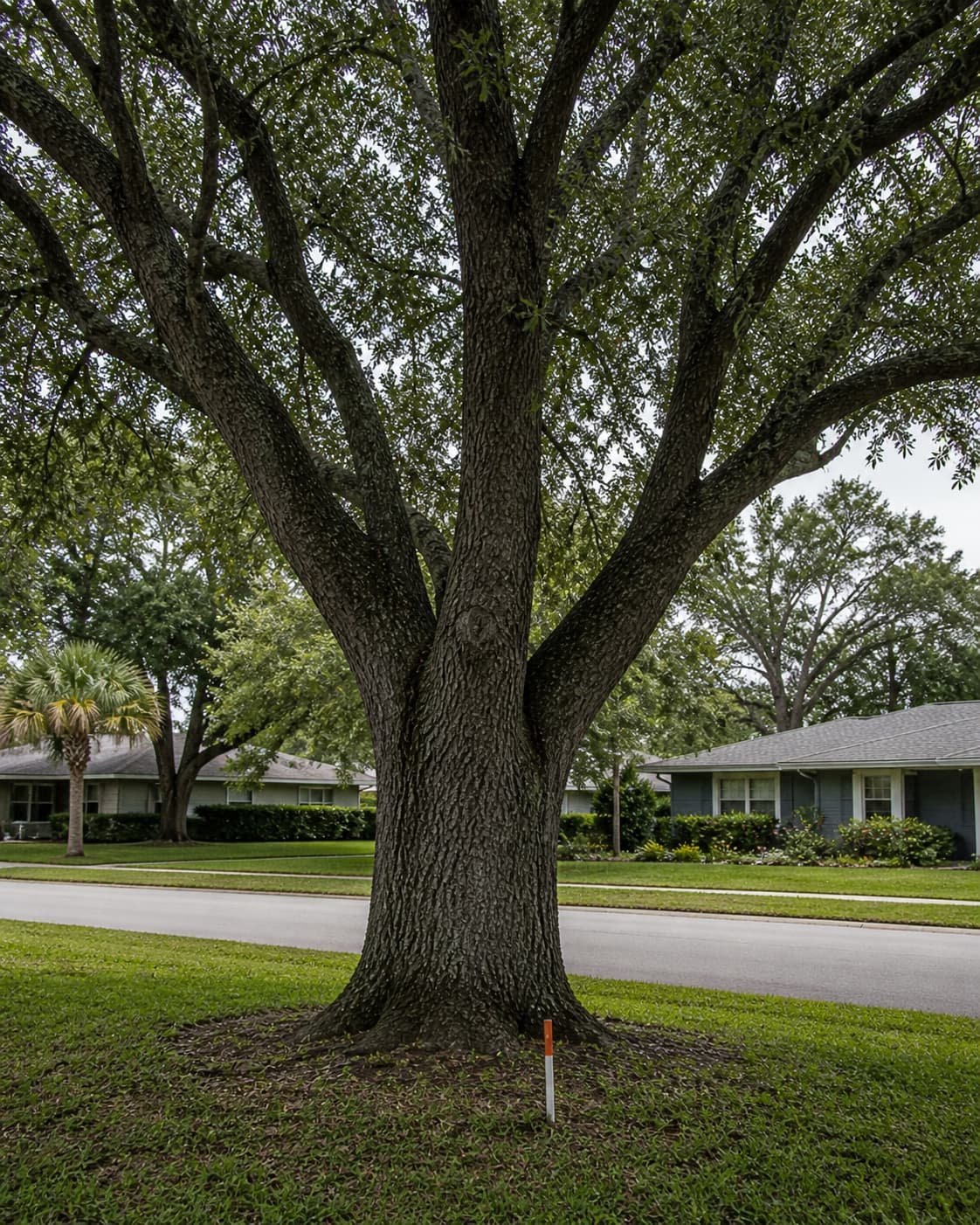
Live oaks are among the most commonly protected trees under the Gainesville tree ordinance. They are one of the most prevalent species in the city’s residential neighbourhoods and one of the most significant contributors to Gainesville’s canopy cover. Laurel oak, slash pine, and other native species can also fall under protection depending on their size. Heritage trees — those that meet a higher DBH threshold or have been specifically designated — receive the strongest protection and are the most difficult to obtain removal permits for.
When Do You Need a Permit?
As a general rule under the Gainesville tree ordinance, if the tree you want to remove meets the DBH threshold, you need a permit. There are some exemptions — trees that are dead, imminently dangerous, or located within a certain distance of a structure may qualify for expedited or emergency permit processing — but the default position is that protected trees require a permit before removal work begins.
Attempting to remove a protected tree without a permit is a violation of the Gainesville tree ordinance and can result in fines calculated on the value of the removed tree. Tree valuation for ordinance purposes uses a formula that takes into account species, size, and condition, and the resulting fines for unpermitted removal of a large heritage live oak can be substantial. It is never worth the risk — the permit process, while it takes time, is straightforward when handled correctly.
The Gainesville Tree Ordinance Permit Process
Applying for a tree removal permit under the Gainesville tree ordinance involves submitting an application to the City’s Department of Sustainable Development. The application requires information about the tree — species, size, location on the property, and the reason for removal. For trees that are dead or posing an immediate hazard, the process can be expedited, but standard permit applications go through a review process that takes time.
Tree Care Gainesville assists customers with the permit process as part of our service. We assess the tree, confirm whether a permit is required, help prepare the necessary documentation, and advise on the likely outcome of the application. For trees that are clearly in decline or posing a genuine hazard, supporting documentation from a professional arborist strengthens the permit application considerably.
Mitigation Planting Requirements
When the Gainesville tree ordinance permits the removal of a protected tree, mitigation is typically required. Mitigation means replacing the removed tree with new plantings — either on the same property or through a contribution to the city’s tree bank. The number and size of replacement trees required depends on the size and species of the tree being removed.
Tree Care Gainesville advises on suitable mitigation species as part of the removal process. Florida’s native species make the best choices for Gainesville’s soil and climate conditions — cabbage palm, slash pine, sweet gum, and young live oaks are all appropriate replacements that will contribute to the city’s canopy over time.
Trees Outside the City Limits
The Gainesville tree ordinance applies within the city limits only. Properties in unincorporated Alachua County fall under county regulations rather than the city ordinance, and the rules differ. If your property is outside the city boundary — in areas such as Newberry, Starke, or other unincorporated parts of the county — different permit requirements may apply. Tree Care Gainesville is familiar with both city and county regulations across our service area and will advise on the applicable rules for your specific property.
For the most current information on the Gainesville tree ordinance, contact the City of Gainesville’s Department of Sustainable Development directly. For guidance on professional tree care standards, visit the International Society of Arboriculture.